

Share





Published on 28 January, 2021
| Last Updated on 23 March, 2023
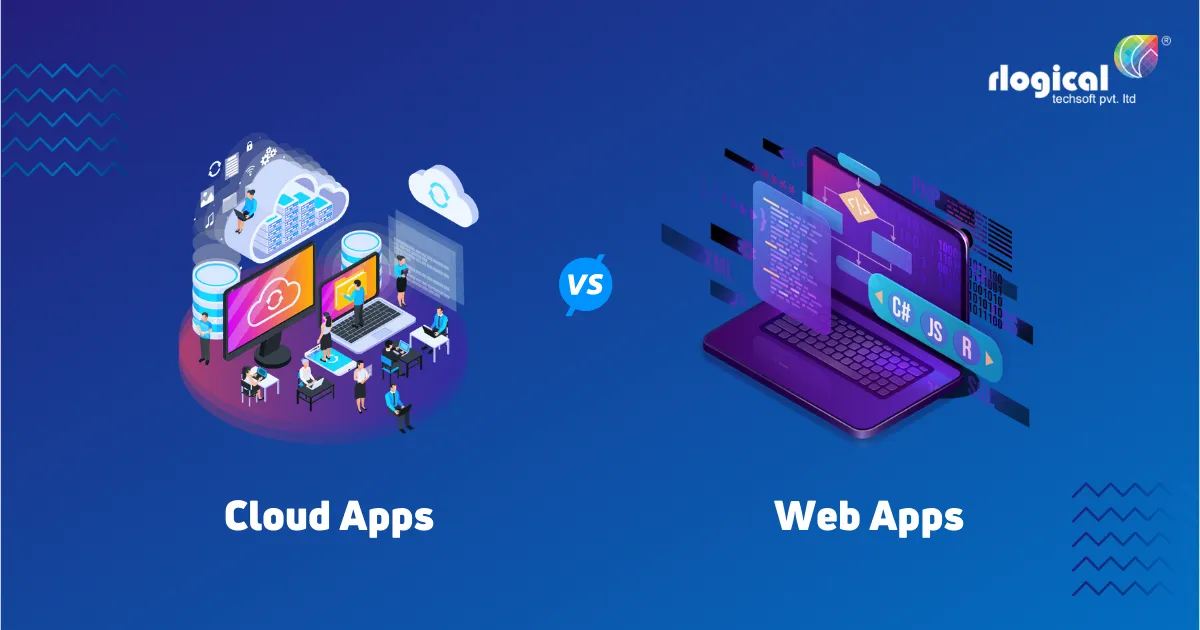
Perhaps you have come across the terms “web apps” and “cloud apps” being used interchangeably despite referring to different things. It is natural for you to get confused, given that these types of web-based apps are almost identical. In the following paragraphs, we have mentioned the primary differences between cloud apps and web apps, along with their respective pros and cons.
These web-based apps rely on Web servers and have been designed to be used on web browsers exclusively. On most occasions, they come with simple architecture while providing limited customization as well. Web apps are known to combine client-side scripting and server-side scripting, in which case the client will depend on the Web server for assessing the services. E-commerce applications and e-banking are some examples of these types of apps.
Web apps are divided into five groups: dynamic, static, portal, animated and content management systems, and e-commerce. The most basic is the static web apps, which are so-called since their content remains the same over time. As compared to static web apps, dynamic web apps happen to be more complicated and come with the possibility of regularly modifying or updating the info held by them. Portable web apps allow users to access different types of pages via a home page, and e-commerce web apps development help in electronic payment collection. A CMS app is used for developing web apps that are being developed continually, such as news pages or personal blogs.
Despite being a web-based program, the data of cloud apps are sorted in a cloud. The primary difference between web apps and cloud apps is this.
Email service will be a proper example of a cloud app where the users will be interacting with the application using a web browser or a mobile gadget. The app’s data will be processed by the local device and cloud computing solution, implying that it is possible to access it online and offline.
On most occasions, cloud applications will be written in any one of these three categories: SaaS (Software as a Service), IaaS (Infrastructure as a Service), or PaaS (Platform as a Service). SaaS happens to be the most typical of these three, where a 3rd-party cloud provider will be managing and hosting the entire app. In IaaS cloud apps, the cloud infrastructure will be rented from a 3rd-party; however, they are in charge of app support, middleware, and apps. Lastly, PaaS cloud apps provide more freedom to the developers, given that they will be able to create and host the apps.
Web Apps |
Cloud Apps |
| Work in browsers | Don’t depend on browsers |
| Can’t work offline | Can work offline |
| Limited scalability | Inherently scalable |
| Limited availability | Very up-time |
| Not all cloud apps are web apps | All cloud apps are web apps |
| Isolated – tenancy solution | Multi-tenancy solution |
| Only run on providers web servers | Can run on the users computing systems or providers web servers |
Below, we have mentioned some features which will help to differentiate between web apps and cloud apps.
The fact is that this will be depending on the app type that you want to develop. A cloud app will be ideal for you if you would like to develop an app with extensive customization and sharing abilities and a high storage load. Nevertheless, if your app is not that ambitious, and you are searching for something affordable without any launch restriction, then a web app will be appropriate for you.
As mentioned earlier, your choice of the type of app will depend largely on its requirements and purpose. However, the good news is that if you like to go for the web app, it is always possible to upgrade to the cloud app afterward.
Rahul Panchal is a visionary technology entrepreneur and the Founder & Managing Director of Rlogical Techsoft Pvt. Ltd. Passionate about the power of Artificial Intelligence, he focuses on helping businesses transform through AI-driven solutions, intelligent automation, and data-centric digital ecosystems. Alongside AI, his expertise spans scalable web and mobile platforms, Cloud, IoT, and modern enterprise technologies enabling organizations to innovate faster, optimize operations, and build future-ready digital products with real business impact.
Global insights on technology trends, best practices, and digital transformation strategies.
A proven track record of high-impact deliveries across industries and technologies
Share with us. We'll assess its feasibility, suggest the right tech stack, and share a clear cost & timeline.
Years of Experience
Projects
Countries
Engineers
Verified Client Reviews
Industry Served